
Honolulu County Civil Docket Searches
eCourt Kōkua is the official statewide search for First Circuit civil cases. It covers District, Circuit, Family civil, Land Court, and Tax Appeal Court information. You can search by a party's name or Case ID. Person searches in the current interface require both a first and last name. A long result list can be narrowed in several ways. Middle name, partial spelling, and phonetic matching all help narrow it. Filing dates and case type do too. An organization gets its own search mode. It covers business and government parties.
Identify the likely court first. A large general civil action may sit in Circuit Court. Limited civil, small claims, and summary possession are District matters. Probate and guardianship are Circuit cases. Family civil records go to Family Court, though public access varies. Open the matching result. Confirm the court, location, filing date, and parties before relying on the register.
- Accept the eCourt Kōkua terms and select Party Search or Case Search.
- Enter the party name or known Case ID and narrow by case type or filing date.
- Confirm First Circuit, venue, parties, and status in the Summary view.
- Read Events for hearings and Dockets for filed papers, minutes, orders, and judgments.
- Purchase an available public PDF or request the item from the correct Judiciary clerk.
Honolulu Civil Jurisdiction Lines
The amount in dispute and the remedy sought both matter. They decide where many Honolulu County civil dockets begin. Circuit Court holds exclusive jurisdiction above $40,000. Nonjury matters from $10,000 through $40,000 are shared between Circuit and District courts. Debt, damages, and property-value disputes up to $40,000 belong to District Court. Small claims reaches $5,000. Summary possession stays in District Court no matter how much is claimed.
Quick distinction: the dollar figure does not control every civil venue question. The remedy can place a case in District Court even when the amount alone suggests a different path.
Probate and guardianship belong in Circuit Court. Family matters belong in Family Court. A public search should therefore use both case type and court, not just a party name. The Circuit Court overview and the District Court overview define this local split.
Civil Dockets: What They Show
A Honolulu County civil court docket separates case facts from the filing history. The Summary tab gives the Case ID, type, status, and last update. It also shows the filing date, court, and location. Related Cases may point to a transfer, a linked proceeding, or an appeal. The Parties tab lists plaintiffs, defendants, petitioners, respondents, attorneys, sequence details, and association end dates. Events covers the settings. Dockets lists the filed items and the minutes.
| Case ID | The local identifier, including civil formats such as 1CCV-19-1. |
|---|---|
| Parties | Plaintiff and defendant, or petitioner and respondent, plus attorneys and associations. |
| Events | Conferences, motion hearings, trials, and judgment-related settings, latest first. |
| Dockets | Complaint, service returns, answers, motions, notices, orders, judgments, and minutes. |
| Documents | Paid public PDF where an icon appears; counter or written request otherwise. |
| Related Cases | Transfers, associated proceedings, and appellate links when entered. |
If your Honolulu County civil case shows no Offenses tab, that is correct. The Judiciary's own manual reserves that tab for criminal dockets alone, so its absence on a civil docket is not a portal error.
Honolulu Civil Docket Timeline
A standard First Circuit civil register opens with a complaint and a civil information sheet. Summons and proof of service follow. The response may be an answer, a counterclaim, or a default step. Motions and discovery entries fill the middle of the record. Settings then push the case toward trial or another dispositive ruling. Judgment and enforcement papers may follow. A possible appeal can come after that.
Docket flow: Complaint › Service › Answer or Default › Motions › Hearing or Trial › Judgment › Enforcement or Appeal
Circuit summons practice generally allows 20 days after service for an answer. That benchmark does not prove a default was entered. Look for the actual request and the ruling. A filed motion also does not show that relief was granted. Match the motion entry to an ORDG or ORDD code. Then check the hearing result and the signed order.
What Cases Fill the Civil Docket
Honolulu County civil court dockets cover several forms of relief, and the same party can appear in more than one court. The case description and filing court give the safest classification. Public Family Court access may be narrower than ordinary civil access.
| Civil matter | First Circuit court | Key docket point |
|---|---|---|
| Major civil claim over $40,000 | Circuit Court | General-jurisdiction filings, motions, trial, and judgment |
| Limited debt, damages, or property value claim | District Court | Up to $40,000, subject to shared jurisdiction |
| Small claim | District Court | Up to $5,000, with a compressed hearing path |
| Summary possession | District Court | District venue applies regardless of amount |
| Probate or guardianship | Circuit Court | Specialized civil case type |
| Family civil matter | Family Court | Access depends on record category and restrictions |
Land Court and Tax Appeal Court matters are also searchable in eCourt Kōkua. These specialized statewide courts are assigned to First Circuit judges.
Honolulu Small Claims Dockets
Small claims runs on a shorter register than a standard Circuit civil action. The claim and service come first, then an initial or trial appearance. If the plaintiff fails to appear, dismissal may follow. A properly served defendant may not appear. The court can require proof before entering default. The decision may be stated orally and then entered as a written judgment.
Official Hawaiʻi guidance says there is no appeal from a small-claims judgment. That differs from an ordinary civil judgment. Such a judgment may lead to a notice of appeal and a separate appellate record. Do not assume a Related Case link will appear after every small-claims result. The local District docket is one key source. So is the written judgment.
District civil venue can point to Honolulu, Pearl City, Kapolei, Wahiawā, or Kāneʻohe. Search the location shown on Summary. Use that division for paper access.
Hearings on the Civil Docket
In eCourt Kōkua, the civil docket lists conferences, motion hearings, trials, and judgment settings from newest to oldest. Read that order carefully. The top line is not always the next hearing. Sort finished events from upcoming ones, and check each setting against the notice filed under Dockets. There is also an official Upcoming Court Hearings search. It works by Case ID or by Oʻahu location and courtroom.
Setting styles differ across the Honolulu County civil docket. Circuit trials can grow out of status conferences and agreed trial weeks. District small claims often sit on a single compact setting. A continuance keeps the old event. It adds a new line, usually marked CON or CHD. One caution matters here. A motion entry is only a request, not a ruling. Look for the event disposition and the order that follows. To confirm a date, follow the full county process in the Honolulu County court schedule.
The notice also tells you whether an appearance is remote or in person. If the portal and the filed notice disagree, call the division or the judge's chambers. Courtesy reminders never replace an official notice.
Older Honolulu Civil Documents
Honolulu civil records moved into JIMS and JEFS in 2019. That shift left older case files behind a practical online cutoff. A docket index may show up. An older complaint, order, or judgment can carry no PDF icon. Start by writing down the exact Case ID, the document title, and the filing date. Then call the correct Legal Documents Branch. The First Circuit public-terminal list points you to terminals. There you can view court case files free on screen.
Branch locations follow the court level. Kaʻahumanu Hale holds Circuit civil files. Legal Documents Branch 2 at Kauikeaouli Hale handles Honolulu District civil files. Pearl City, Kapolei, Wahiawā, and Kāneʻohe each serve their mapped District venues. For visits, bring Form 1C-P-858. For written requests, use Form 1C-P-827 and send it by the listed mail, fax, or email route.
Expect invoices before payment on written work. Responses take at least ten business days, and mailed requests run 15 to 20 business days. Microfilm, off-site material, and multi-file orders can stretch longer.
Who Can See Civil Dockets
Hawaiʻi Court Records Rules presume the Honolulu County civil docket is public. A law, rule, or order can still make an item confidential, restricted, protected, or sealed. Even then, the docket may list a sealed or in-camera entry. It does not show the contents. Family matters and documents holding protected personal information call for extra care. One more rule settles disputes. When a filed document and an electronic database field conflict, the filed document controls. That rule holds unless a court says otherwise.
Access rules:
Hawaiʻi Court Records Rules 3.1, 4, 5, 9, and 10 cover the case register, record contents, privacy duties, and public access.
Rule 10.6 allows oral, written, or electronic requests with enough detail to locate the record.
Rule 10.10 requires notice and an availability estimate when fulfillment will exceed ten business days.
The clerk can point a requester to free remote docket access. The court docket itself stays free. Even so, the clerk must still provide any certified copy requested under the rules. Someone outside an authorized confidential-access class needs a proper court order. An ordinary public request will not do.
Honolulu Civil Copies and Fees
Looking at the docket is free, but documents and certified copies cost money. eCourt Kōkua charges $3 per online document or 10 cents per page, whichever is greater. Electronic certification adds $2 per document. At the clerk's counter, paper copies run $1 for the first page. Each later page costs 50 cents. A search without a case number costs $5 per exact name.
The official First Circuit fee schedule lists those amounts. The Judiciary also posts an Oʻahu Circuit Court forms set for this civil docket page through its Circuit Court forms collection.
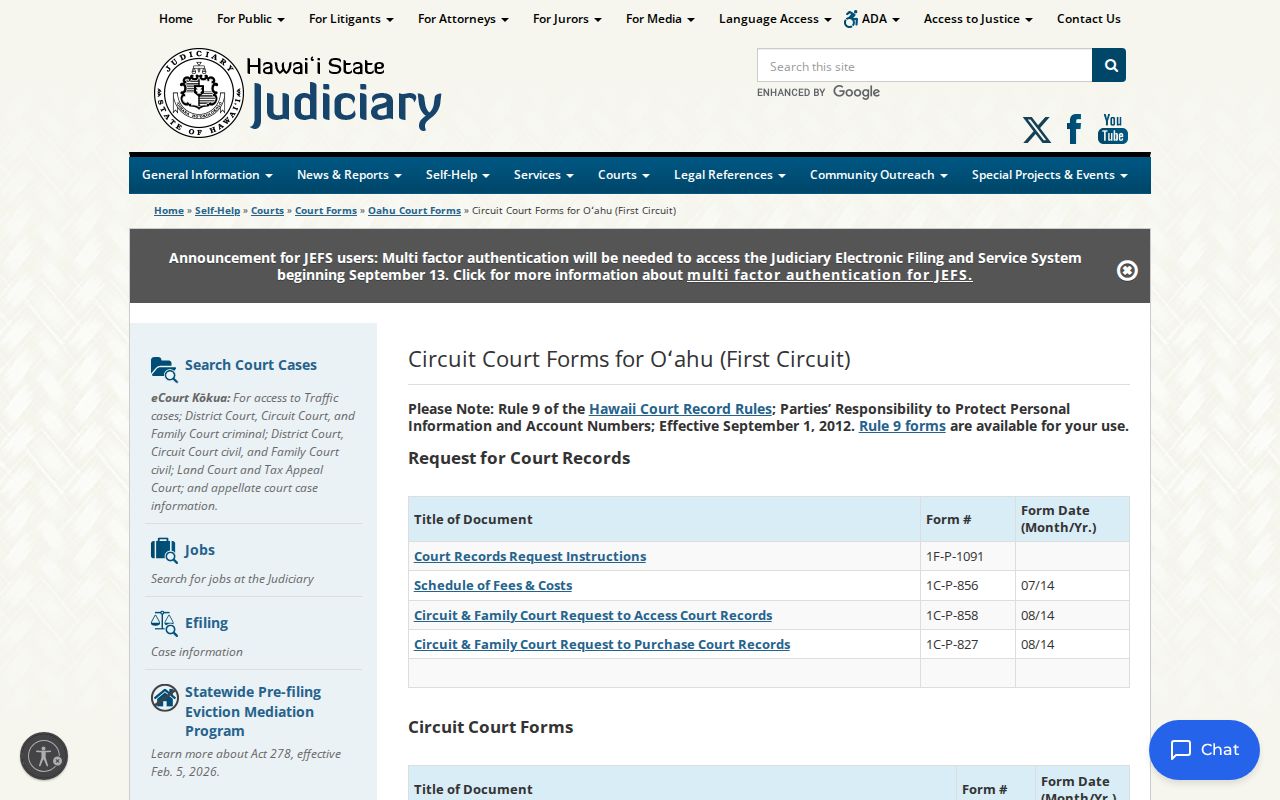
That collection helps you name a filing type, but the docket and the clerk tell you what was actually filed in a given case. Certification only authenticates a copy. It does not change the case result. On any request, state the exact document, the count, and whether you want certification, which keeps delay and cost down.