
Traffic Case Records in Honolulu County
Where do traffic and parking cases go in Honolulu County? They land in the District Court of the First Circuit. Hawaiʻi has no municipal court tier. A ticket written in Honolulu or anywhere else on Oʻahu belongs to the state District division covering that spot. It never goes to a city clerk. Kauikeaouli Hale is home to the Honolulu District Court and its Traffic Violations Bureau. Rural District divisions handle cases from Pearl City, Kapolei, Wahiawā, and Kāneʻohe.
The Judiciary's traffic case records page points the public to eCourt Kōkua. A search there returns case status, court and location, events, docket entries, and financial codes like FIN, FP, and FS. Treat what you see as public case information. It is not a certified abstract.
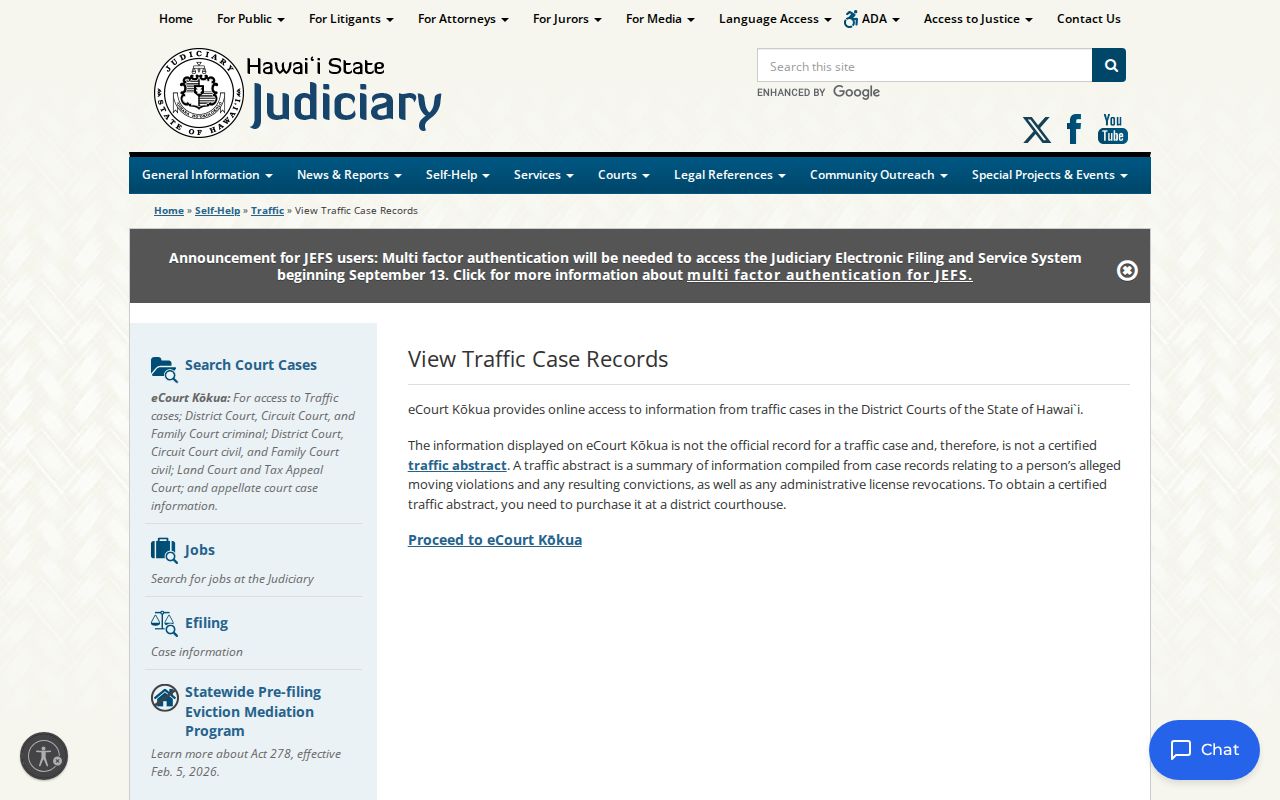
The state search route reflects Honolulu County's state-run court structure.
Two Honolulu Traffic Court Portals
Two portals, two jobs. eCourt Kōkua finds the case, and it lets you pull up a citation by traffic key and read hearing or docket details. eTraffic Hawaiʻi is only for payment, and only when you admit responsibility and pay the full amount on an eligible parking or traffic infraction. The services are not interchangeable.
| Service | Purpose | Key limit |
|---|---|---|
| eCourt Kōkua | Search citation, case, vehicle, events, and docket information | Public result is not certified |
| eTraffic Hawaiʻi | Pay an eligible infraction after admitting responsibility | Cannot deny, mitigate, or handle mandatory appearances |
Online payment works only inside the stated response window and once the ticket has entered the system. After a court appearance or order, it shuts off. If a general portal screen conflicts with your citation or a later court notice, follow the notice.
Honolulu County Traffic Ticket Lookups
Search with the strongest key you have. The current eCourt interface accepts a citation number, Case ID, license plate, or VIN. That statewide system doubles as both the Honolulu County search and the state portal. No separate Honolulu municipal database exists.
- Read the citation and identify its number, response date, and issuing court information.
- Open eCourt Kōkua, accept the disclaimer, and complete reCAPTCHA if prompted.
- Search by citation or Case ID, or use Vehicle Search with a plate or VIN.
- Open the case Summary, Events, and Dockets, then note the location and next setting.
- If nothing appears, call the Traffic Violations Bureau, visit the District counter, or request the record from the proper branch.
Prefer the phone? The Honolulu traffic line is 808-538-5500, and the records-request directory lists 808-538-5100 for the unit. Without a usable online result, visit Kauikeaouli Hale or the rural District division holding the case. A written Judiciary record request is another fallback. This is not a City and County public-record request.
New Honolulu Tickets Can Lag
A brand-new ticket may take 13 days or more to show up. That lag can hide it from both the traffic case search and the payment service. A blank screen is not a dismissal. Never wait past the response instructions printed on the citation, because the online clock does not replace the legal response date.
First recheck the citation number for transposed digits. Then try a plate or VIN search. If the online result still fails, call the District traffic unit with the citation in hand. eTraffic runs Monday through Saturday from 4 a.m. to midnight HST and Sunday from noon to midnight. Service hours never extend a deadline.
Note: A citation's printed date may differ from a later hearing notice, so confirm the active setting with the court record and the clerk.
Traffic Court Dates in Honolulu County
How do you confirm a Honolulu County traffic setting? The eCourt Kōkua Upcoming Court Hearings search does it by Case ID. Its court-and-location mode also works with island, courthouse, courtroom or division, and a date range. Results can shift. Cross-check the hearing search against the case Events tab and the newest filed notice under Dockets.
| Citation or Case ID | A citation number or a First Circuit identifier such as 1DTA-26-1; use the exact identifier shown in the case |
|---|---|
| Court and Location | The First Circuit District division that holds the traffic case |
| Date and Time | The active hearing setting, subject to later court action |
| Courtroom or Division | The room, calendar, or judicial division shown by the hearing result |
| Status | Pending or resolved case status, read with Events and Dockets |
A continuance can leave the old event on screen while adding a new one. Codes CHD and CON stand for change of court date and continued. Find the newest future event and verify it against the filed notice. eReminder is only a courtesy backup, never official notice.
Honolulu Traffic Records by Volume
First Circuit traffic volume is huge. That is why careful search keys matter. Official FY2023-24 statistics report 207,919 traffic-infraction filings and 17,694 traffic-criminal filings. Parking alone made up 93,086 infraction filings. Registration, safety, equipment, speed, and photo red-light matters formed other large groups.
Numbers like those explain why citation, Case ID, plate, and VIN beat a broad search. They also show why Honolulu County traffic records cover both civil infractions and traffic crimes. Those two track different appearance and payment routes.
Paying a Ticket vs Fighting It
A payable infraction generally demands a response within 21 days. Paying admits responsibility. Denying asks the court to decide. A third path, admitting with an explanation, seeks mitigation. Traffic crimes and mandatory appearances follow the citation, summons, bail receipt, or court notice instead. The official Hawaiʻi traffic case options lay out these response paths.
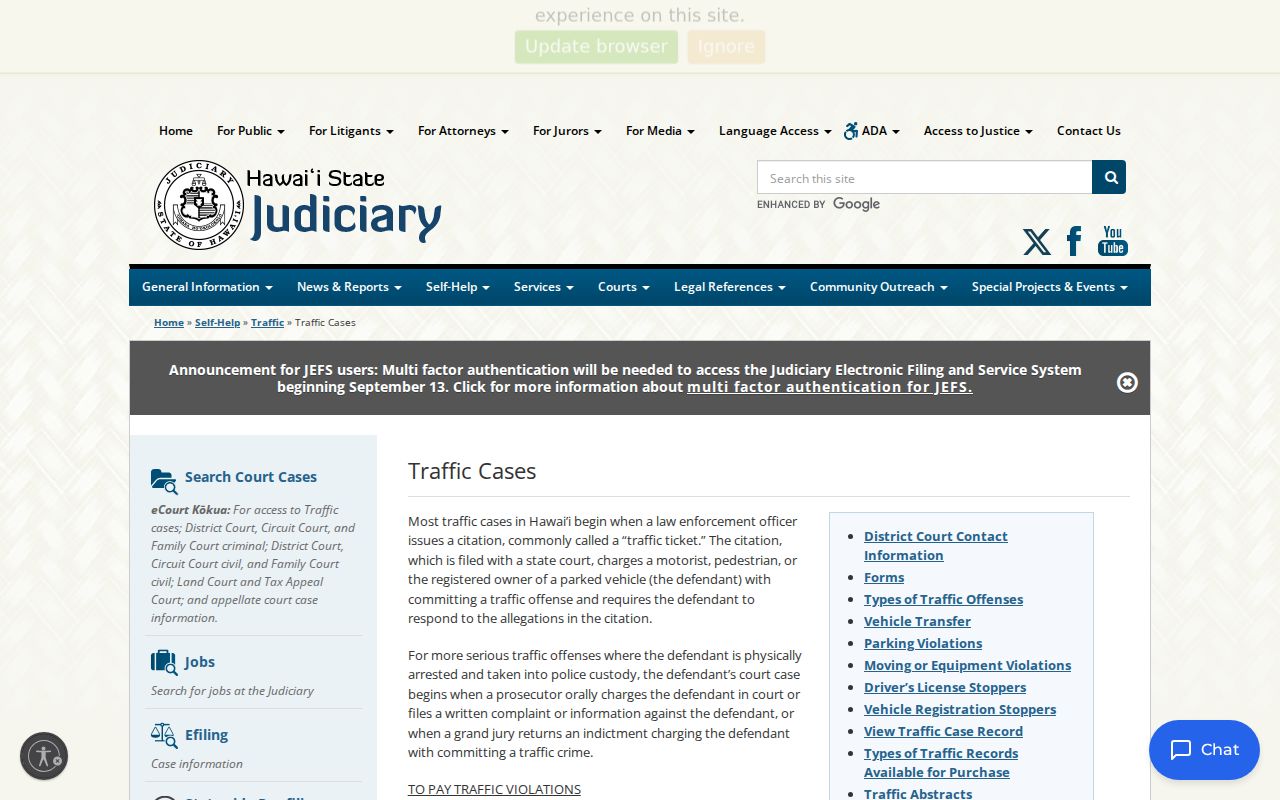
Whichever choice you make changes the process and the next entry in your Honolulu County traffic court record.
| Admit and pay | Deny | Admit with explanation |
|---|---|---|
| Pay the total online, by mail, at the District counter, or by the stated phone route | Send a written statement or request a hearing | Request mitigation or submit a written explanation |
| Ordinarily respond within 21 days | Ordinarily respond within 21 days | Ordinarily respond within 21 days |
| Records admission and payment | Court mails the hearing date, time, and place | Mitigation decision is final under the official FAQ |
Failure to appear: Missing a required traffic-crime appearance can lead to a bench warrant. Failure to respond or comply may also require payment, compliance, or a motion to set aside default.
Honolulu Traffic Stoppers After Act 243
Act 243 rewrote HRS §291D-12 in 2025. Now an unpaid fine, missing community service, or an unsatisfied judgment alone will not suspend your license or registration. Honolulu County drivers still face stops for other reasons. Skipping a hearing, ignoring a traffic-crime summons, or breaking a court order still triggers withholding under the old logic. Read the actual traffic docket before assuming the worst. The entry tells you whether the problem is nonpayment, failure to appear, or some other failure to comply. Then contact the court that holds the case.
If a default was entered, timing matters. A motion filed within 90 days needs good cause plus an appearance bond equal to the judgment, under the cited guidance. After that window, you must show exceptional circumstances instead. So check the docket dates early and act while the simpler path is open.
Two Honolulu Traffic Record Custodians
Two different offices hold two different records. The First Circuit District Court keeps the citation case file itself. The state licensing and transportation record tracks license facts and reported actions instead. Neither one replaces a certified traffic abstract. District Court also issues that abstract under a defined statute. Checking one Honolulu County record is not checking all.
| Court traffic record | Driver history record | |
|---|---|---|
| Custodian | District Court and Traffic Violations Bureau | State licensing and transportation system |
| Shows | Citation, events, docket entries, case status, and court disposition | License class, expiration, violations, and suspensions |
| Access | eCourt Kōkua, terminal, counter, or record request | Separate state record request |
The Judiciary's traffic abstract instructions distinguish the court products.
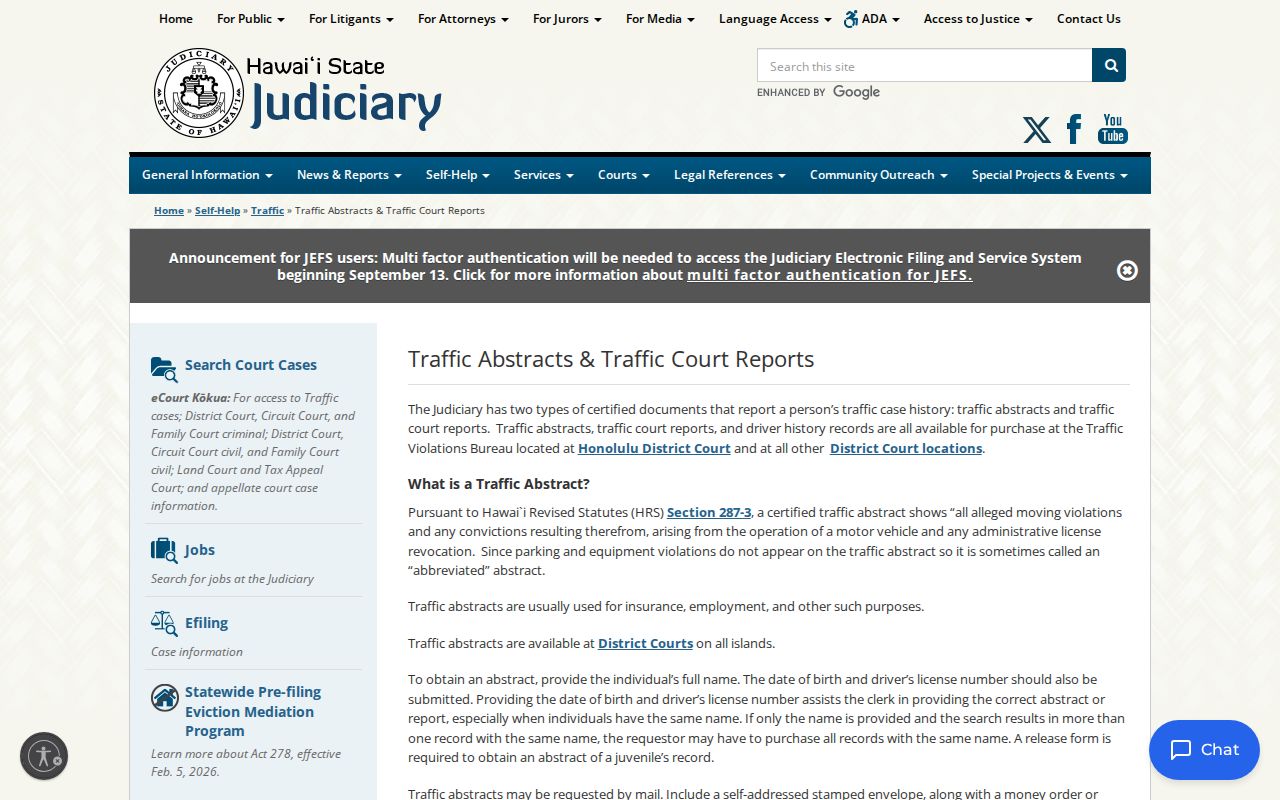
A certified abstract lists moving allegations, convictions, and administrative revocations, but leaves out parking and equipment matters.
Honolulu Traffic Abstract or Report
Honolulu offers more than one way to pull a traffic record. An eCourt result is free. It is not certified. The certified traffic abstract is a statutory District Court product. A traffic court report is wider. It adds equipment and parking matters. Only the person named on it can get one, in person, with photo identification. A driver history is a fourth product from a separate record system.
The official traffic record types and fees page lays out the differences between these products.
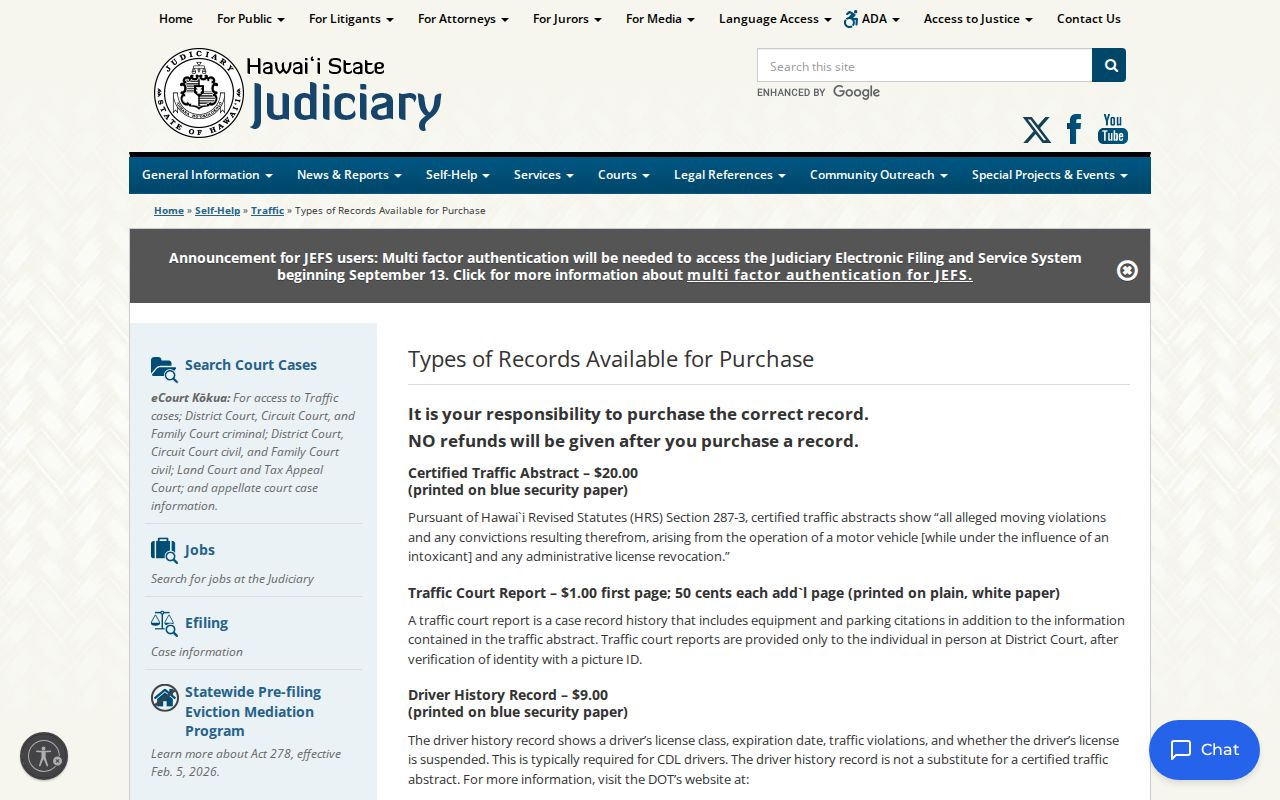
That comparison matters. It can save you from paying for a low-cost court report when what you actually need is a certified abstract.
Honolulu Traffic Record Copy Fees
A certified traffic abstract costs $20. To order by mail, send your full name, date of birth, driver-license number, a self-addressed stamped envelope, and a money order or cashier's check payable to District Court. Personal checks are not accepted for that route. A juvenile abstract requires a release.
| Record | Fee | Access |
|---|---|---|
| eCourt traffic docket | Free | Public online search, not certified |
| Certified traffic abstract | $20 | District counter or mail request |
| Traffic court report | $1 first page; $.50 each later page | Named person in person with photo ID |
| Driver history record | $9 | Separate state record channel |
The governing HRS §287-3 traffic abstract law defines the abstract's court-record scope.
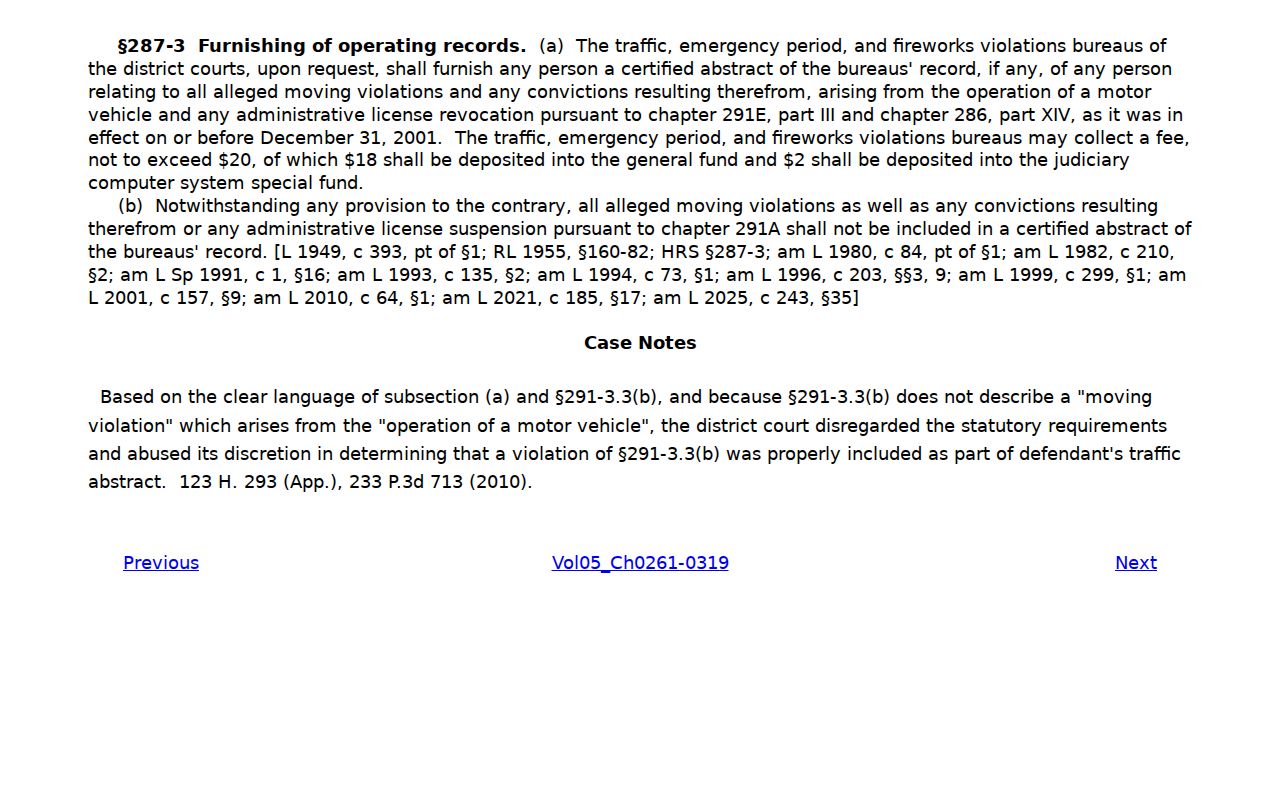
Why doesn't a traffic abstract copy every visible entry in a citation docket? The statute explains it.
Honolulu Traffic Options Stay Local
Honolulu County offers no standard defensive-driving dismissal program and no deferred-disposition dismissal of its own. That matters. Do not borrow eligibility rules from another state and assume they apply here. A judge can still order driving school. Documented hardship can support community service or an adjusted assessment. The court's actual order controls the Honolulu County case.
Automated enforcement runs on Hawaiʻi law. Act 212 widened the automated-speed procedure under chapter 291D. It added police verification and response paths. Some automated-enforcement entries get distinct treatment in statutory abstract rules. So search the citation, read the court record, and follow the notice the court issued. The wider Honolulu County court schedule page can help confirm an active setting.
Note: eCourt Kōkua shows the court case. eTraffic Hawaiʻi only handles eligible payment, and it never decides a contested citation.